

There is no universally correct mix of venturing instruments. What works for a large energy company building revenue streams beyond its core grid business looks very different from what works for a B2B manufacturer trying to access new technologies through startup collaboration.
The main question every new business leader needs to ask is:
“Which kind of venturing really makes sense for us?”
What each instrument does — and doesn't do
The four main instruments have genuinely different strategic purposes.
Venture clienting (VCL) is fast and low-risk. You collaborate with startups on specific problems, test new technologies, and feed your ideation funnel. The trade-off: limited control, limited upside beyond the core business.
Corporate venture building (CVB) gives full control and can generate sizeable new revenue streams. It's also the most resource-intensive and the hardest to do well. Starting from zero is hard; starting from zero without the right operating model is how you waste years.
Corporate venture capital (CVC) follows a VC-type logic: minority stakes, financial and strategic returns, access to market intelligence. It works best as part of a broader portfolio, not as a standalone play.
Venture acquisition gives full control fast, but at high cost and with integration complexity that is easy to underestimate.
Company creation funds (CCF) are a less common but strategically distinct instrument. Rather than building ventures inside the corporate structure or investing in existing startups, a CCF pools capital to systematically create and spin out new companies — typically with external founders brought in from the start. The upside is speed and entrepreneurial quality; the trade-off is that corporate control and integration are limited by design. CCFs work best when the organisation wants to generate a portfolio of independently viable businesses, rather than ventures that need to integrate back into the core.
How to choose
The 50% of new business builders in our 2026 study who choose instruments based on strategic purpose are asking the right question first: what are we trying to achieve, and which instrument best serves that ambition at this stage?
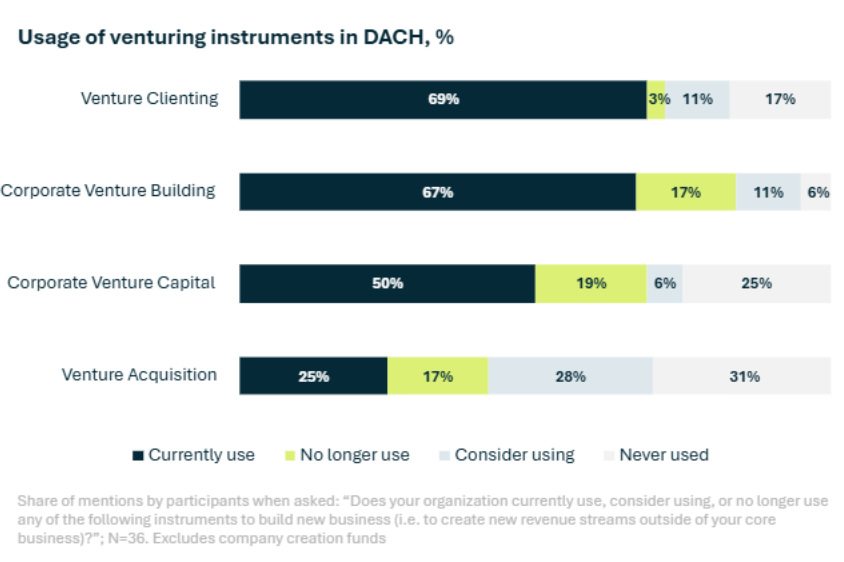
Once you've identified an opportunity field (trhough foresight), the market landscape indicates which instrument fits. If no solutions exist yet, build. If solutions exist but none have clearly won, build or acquire and integrate. If the market is already well-served by strong startups, partner through venture clienting or invest via CVC rather than competing head-on.
A best practice: VNTR
PostFinance's VNTR unit (as featured in our 2026 study) applies a clear version of this logic: venture clienting and foresight work identifies and shapes innovation fields, venture building executes on the most promising opportunities, and CVC plays a complementary financial and strategic role. Each instrument serves a distinct purpose in the same system.
The more strategic clarity you have — on what new business building needs to achieve and over what time horizon — the more obvious the instrument selection becomes.
For more on how DACH organisations are combining and sequencing venturing instruments, the full data is in our study "The state of new business building 2026."
The state of new business building 2026
New business building is shifting: Resources are tighter. Expectations are higher. This study shows how new business builders in DACH are responding and which ones are pulling ahead.



.jpg)