.jpg)

To survive and thrive in an ever-evolving marketplace, businesses need to embrace change and be willing to challenge the status quo.
This article highlights the urgent need for corporate venturing when facing the limits of your core business and development plateaus.
The incremental innovation that can be wrung out of an existing product is limited.
For corporate survival and staying ahead of disruption, we at whataventure believe diversification and building new revenue streams are essential. Diversification into new ventures is the crucial basis for long-term success. How this can be done with strategic clarity is at the core of the Venture Operating Model.
Venture Operating Model: A Framework to Align Goals.
.png)
The Venture Operating Model is a strategic framework that aligns a company's venturing activities with its overall goals. It helps companies systematically create new business units, diversifying from their core operations while ensuring that all ventures are properly supported and executed. This structured approach allows businesses to develop new, sustainable growth paths beyond the existing revenue streams. We developed the framework based on our longstanding experience in all forms of venturing.
Read more about the framework in this article.
Why is Corporate Venturing Important?
The “S-Curve” Reality: Technology Maturation and Market Saturation Define the Limits
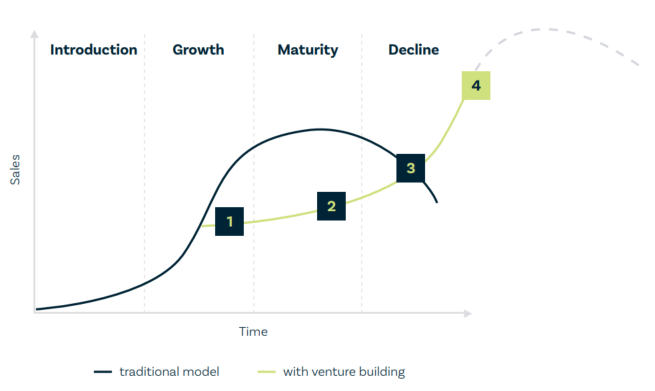
Over time, every revenue stream faces technological maturity or market saturation. The S-curve model shows how industries reach a plateau when innovation slows down. For instance, markets for technologies, like combustion engines or smartphones, are reaching their limits. In such situations, companies must venture beyond their core offerings to remain relevant.
The Numbers Game: Why a Wide Funnel is Key
By exploring various ventures at different stages, companies increase their chances of finding high-impact projects. Similar to venture capital firms spreading risk across multiple startups, businesses should diversify their innovation efforts. The more projects you explore, the higher the likelihood of finding successful new ventures. A healthy venture funnel always has projects being pushed across all stages.
Challenging the Status Quo - With a Clear Plan
The Appeal of the “Known” vs. the Need for Diversification
Many businesses are tempted to invest in what’s familiar, improving existing products or services. However, this incremental approach leads to limited differentiation, intense competition, and price wars.
Sticking to what is known may seem less risky, but it ignores the need for diversification and future growth. In a fast-changing environment, sticking to where you are, might be the riskiest option of them all. Businesses that do not challenge their assumptions or explore new markets are often left behind.
The Venture Operating Model provides the strategic clarity necessary for successful venturing. With a clear plan in place, companies can navigate the uncertainty of innovation and turn new ideas into profitable ventures.
Conclusion
Corporate venturing is no longer optional but essential for survival in a rapidly changing market. The Venture Operating Model offers a structured approach to innovation, enabling businesses to create new growth opportunities while staying aligned with their core strategy. By embracing venturing, companies can build resilience, diversify revenue, and thrive amidst disruption.
The Venture Operating Model: Systemizing new business creation
Gain strategic clarity across structure, governance, and execution with the Venture Operating Model. This framework ensures that venturing is rooted in strategic reasoning and systematically executed.


.jpg)