

We surveyed 50+ senior new business leaders across DACH for our 2026 study. We spoke to Heads of Corporate Development, New Business, Strategy, Venturing. Organisations across energy, manufacturing, financial services, and beyond participated.
Finding 1: Strategic alignment is the dividing line
77% of new business builders who consider themselves successful derive their opportunities directly from corporate strategy. Among those who consider themselves unsuccessful, that number is 18%.
That gap does not close itself. It reflects a fundamental difference in how these organisations have structured the relationship between their corporate strategy and their new business building activities.
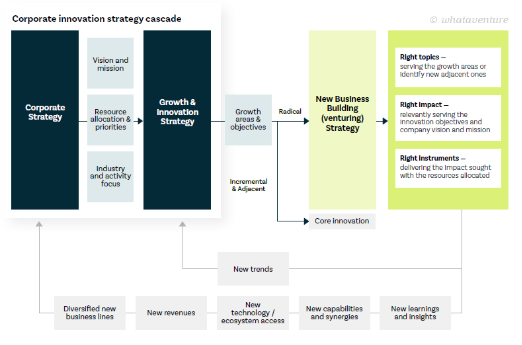
The "Corporate innovation strategy cascade" in our study maps how this connection should work: corporate strategy defines resource allocation and industry focus, which feeds a growth and innovation strategy, which in turn defines the search areas for new business building. The result, when the chain is intact, is the right topics, the right impact, and the right instruments.
When the chain is broken, new business building operates on assumptions. And assumptions are expensive.
Finding 2: Instruments are shifting
69% of organisations currently use venture clienting. 67% use corporate venture building. CVC usage has dropped: 19% of participants say they no longer use it. Venture acquisition remains the least common approach at 25%.
The shift isn't random. Organisations are moving toward instruments that deliver clearer strategic returns with leaner setups. 50% of participants choose instruments based on strategic purpose - by far the most common guiding factor. Those who don't tend to accumulate instrument portfolios that are hard to justify when resources tighten.
Finding 3: Operating model is where strategy meets reality
Strategy alone doesn't deliver results. 44% of participants report struggling with governance. 42% with top management commitment. 36% with strategic direction and freedom to act.
These numbers point to a consistent gap between stated intent and operational reality. Good governance in new business building means fast decisions, clear mandates, and top management commitment that is structural rather than occasional. Organisations that have this in place move faster and kill bad ideas sooner.
Finding 4: Resources are down. Confidence is up.
39% of participants report decreased resources over the past 12 months. At the same time, two thirds believe new business building will contribute to their organisation's growth and stability over the next five years.
That combination is not a contradiction. The organisations that have used the current pressure to sharpen their focus, tighten their operating models, and eliminate activity that wasn't delivering are in a stronger position than they were two years ago. Leaner and more strategically relevant.
What the study covers
The full study goes deep on each of these areas: how successful organisations identify and filter opportunities, how they choose and sequence venturing instruments, how they build governance models that enable speed, and what the most effective operating models look like in practice.
It includes seven case studies from organisations including Bosch, Sennheiser, Raiffeisen Bank International, and PostFinance.

The state of new business building 2026
New business building is shifting: Resources are tighter. Expectations are higher. This study shows how new business builders in DACH are responding and which ones are pulling ahead.



.jpg)