
Why sequence matters
We have worked on 40+ new business launches. The projects that struggled, rarely had a strategy problem. They had a sequencing problem. Teams were asking scaling questions during validation. Or committing to product development before the core market assumptions had been tested. Good ideas, wrong moment.
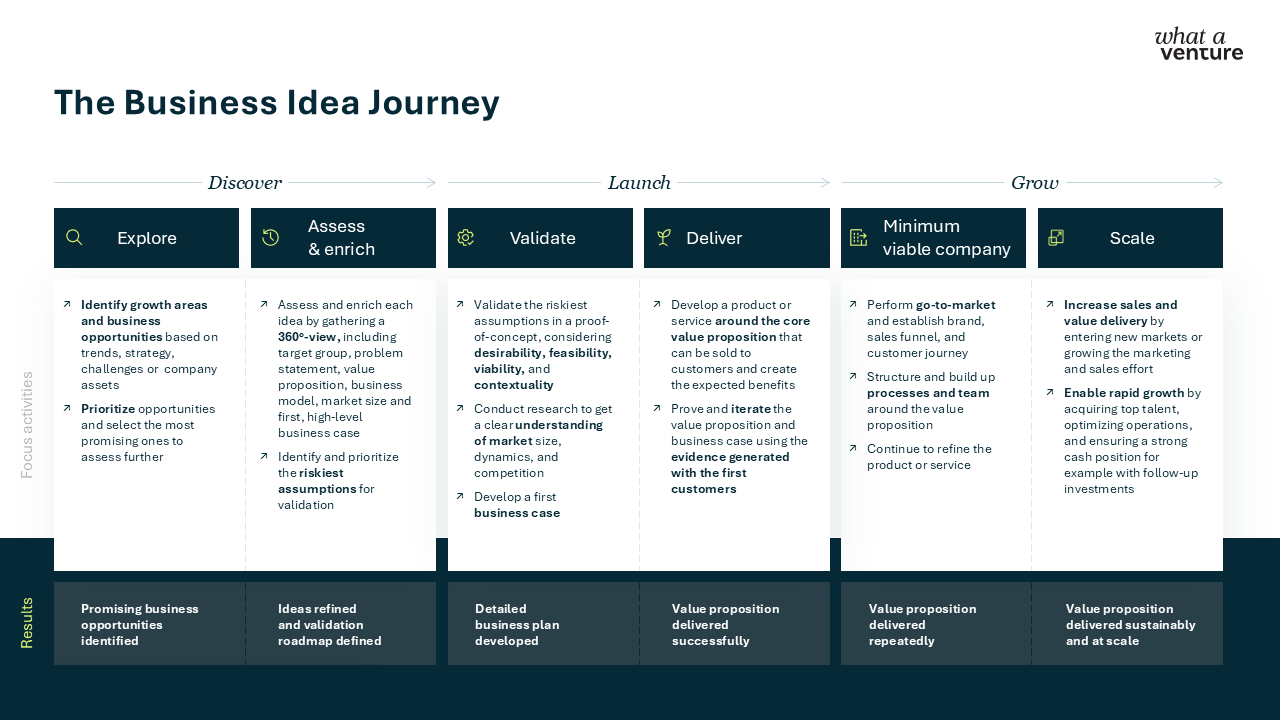
The Business Idea Journey: a structured process with one decision per stage
Six stages, three phases (Discover, Launch, and Grow). Each stage has specific activities and a defined result. Not a milestone in the traditional corporate sense. Rather a piece of real-world evidence. A validation roadmap defined. A value proposition successfully delivered. Then repeatedly. Then at scale.
The framework creates a shared reference point for everyone involved - from the team building the product to the leadership deciding whether to fund the next phase. When everyone is oriented around the same stages, the conversation changes. Less politics, more evidence.
Each of the six stages has one decision at its centre
At the end of the Explore stage, the decision is which opportunities are worth pursuing at all. The goal is to identify genuine growth areas and make a first, honest prioritisation.
In the Assess stage, the decision is which assumptions carry the most risk. The job is to find the ones that, if wrong, would kill the business — and line them up for testing.
In the Validate stage, the go-decision is based on whether the riskiest assumptions hold. The framework tests four dimensions: desirability, feasibility, viability, and contextuality. If the proof of concept doesn't hold, the decision is to stop or pivot. That is not failure, but that is the framework working.
At the Deliver stage, the decision is based on whether the value proposition can be delivered to a paying customer. Not in theory. In practice, whether the value proposition can make customers happy who chose to buy it.
At the end of the Minimum Viable Company stage, the decision is based on whether that value proposition can be delivered repeatedly. One successful sale is not a business. Consistent delivery, in an organizational setup is.
At the Scale stage, the decisions on continued funding are based whether the business is able to grow without breaking what already works. This is the stage most teams are impatient to reach — and the one that rewards everyone who did the earlier stages properly.
The Business Idea Journey sits inside a larger framework for making new business repeatable
A clear process for moving ideas through stages is only one piece of the picture. The Venture Operating Model addresses the larger question: how does a corporate organisation set itself up to build new business systematically, not just once. It brings together strategy, structure, governance, and execution into one coherent framework.
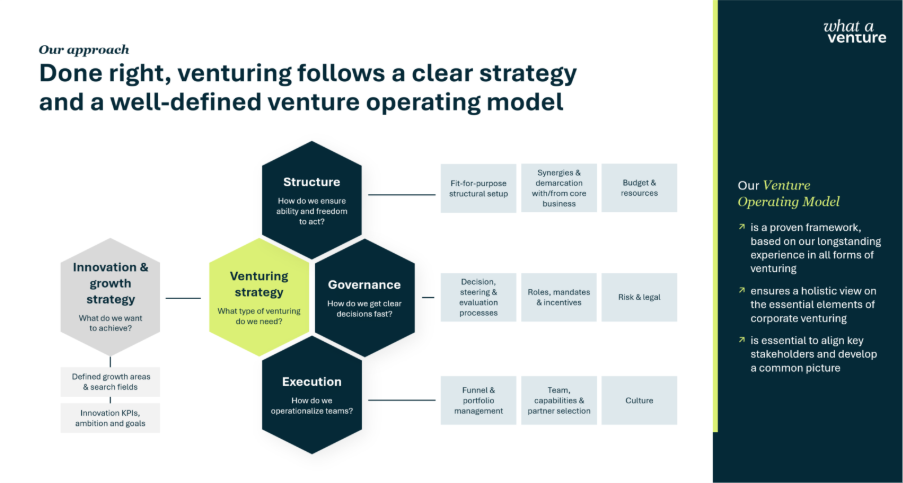
The Business Idea Journey lives inside governance - defining how decisions get made at each step and who owns them. Without that clarity, teams hold on to ideas past the point where the evidence stopped supporting them, or skip validation under time pressure. Both patterns are expensive.
The question worth asking about any active project right now
Which of the six stages is it actually in? And is the decision your team is focused on the right one for that stage?
Talk to one of our experts!
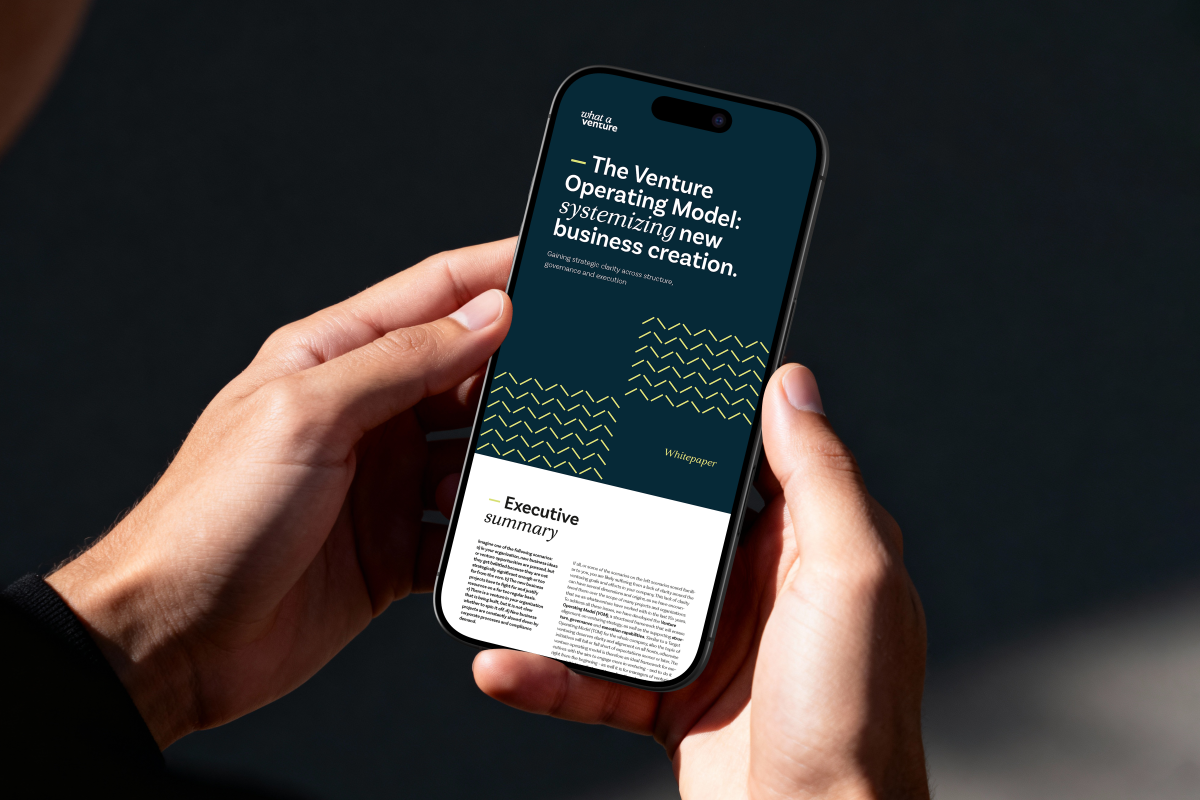
The Venture Operating Model: Systemizing new business creation
Gain strategic clarity across structure, governance, and execution with the Venture Operating Model. This framework ensures that venturing is rooted in strategic reasoning and systematically executed.

.png)


.jpg)