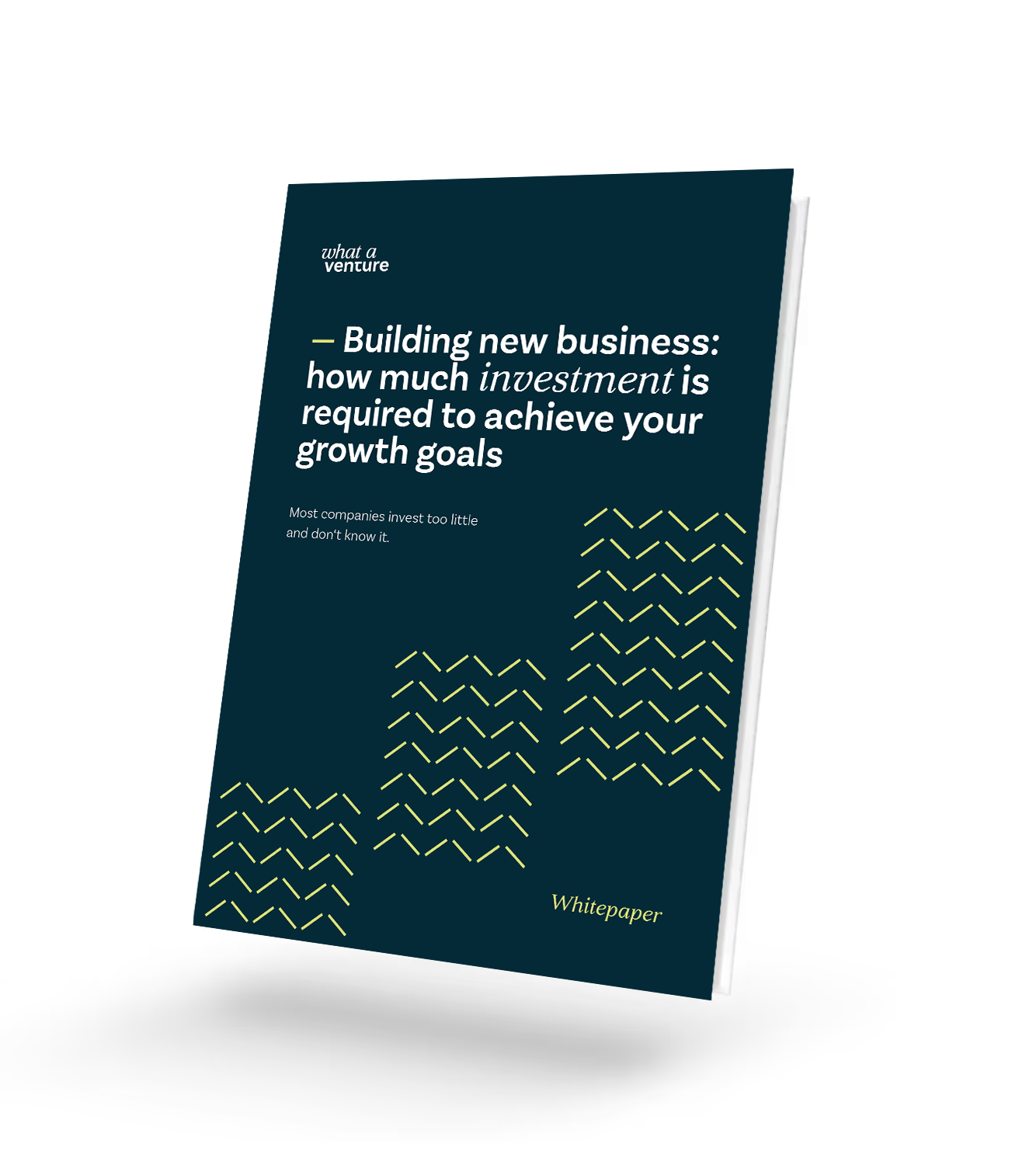
Building new business: how much investment is required to achieve your growth goals.
Most new business budgets are set at the level of internal political tolerance, not at the level the ambition requires. The Calculator gives you the number that changes that conversation. No business case needed.

Is your new business budget set to match your revenue target?
If your answer is "No", you are not alone. Until now there was no established methodology for connecting a new business revenue target to the investment it actually requires. So most budgets are negotiated, not calculated.
With the whataventure new business calculatore we changed that.
Enter your revenue goal and timeline, and the Calculator returns the Justified Investment for your ambition.
Your inputs are used only to run the calculation — nothing is stored or shared.
Der Experteninhalt, der Ihre Unternehmensstrategie prägt
Erhalten Sie kuratierte Einblicke in Unternehmensinnovationen und Geschäftsneugründungen, die Sie anderswo nicht finden
New Business Calculator
What is your maximum justified new business building budget?

| Revenue | EBITDA | |
|---|---|---|
| Before Present Value Adjustment | — | — |
| After Present Value Adjustment | — | — |
| Present Value Revenue | Present Value EBITDA | |
|---|---|---|
| Before risk adjustment | — | — |
| After risk adjustment | — | — |
- Multiplying the EBITDA of the terminal year with the Multiple
- Discounting it for Present Value
- Adjusting by the Portfolio Success Rate
Methodology based on Damodaran/NYU Stern industry multiples, McKinsey corporate venture data, and CalcMastery WACC benchmarks.
A realistic budget range
50 to 100% of the Justified Investment is the realistic budget range to hit your target. Below 50%, the probability of achieving the revenue goal drops significantly. Above 100% can still make sense, depending on your growth ambitions beyond year 10.
If the gap between your number and your current budget is large, the whitepaper explains exactly what your options are.
Based on M&A Methodology
When corporates buy a business, they pay a price derived from future earnings, discounted for time and risk. The Calculator applies that same logic to building: your revenue target becomes an implied enterprise value, adjusted for portfolio success rates and cost of capital. The result is what that revenue stream is worth to acquire. Which is what it should cost to build.
Insights from 50 new business builders across DACH
.png)
.png)
.png)

.png)

.png)
.png)
.png)


What is it about?
Who is it for?
Where the number comes from: The whitepaper enables you to explain it.
The whitepaper explains what drives the numbers you get from the Calculator, where the thresholds sit, and what happens if you adjust the timeline instead of the budget.
M&A methodology applied to building
When a corporate acquires a business, it pays a price based on future earnings, discounted for time and risk. The Calculator applies that same logic in reverse: your revenue target implies an EBITDA, that EBITDA implies an enterprise value, and that enterprise value, adjusted for portfolio success rates and cost of capital, becomes your justified investment.
Halving the timeline roughly doubles the required investment
Reaching €50M in revenue in 5 years requires roughly twice the investment of reaching the same target in 10. Not because the ambition is bigger, but because faster scaling demands earlier capability build-up, stronger teams, and heavier go-to-market spending. The timeline is a budget variable, not just a planning assumption.
Underfunding is not the conservative choice
Below 50% of the Justified Investment, the probability of hitting the revenue target drops significantly. That is not an opinion, it is the output of the same valuation logic. A smaller budget does not reduce the risk of the initiative. It limits the opportunity, while the ambition and the team pressure remain unchanged.
M&A methodology applied to building
When a corporate acquires a business, it pays a price based on future earnings, discounted for time and risk. The Calculator applies that same logic in reverse: your revenue target implies an EBITDA, that EBITDA implies an enterprise value, and that enterprise value, adjusted for portfolio success rates and cost of capital, becomes your justified investment.
Halving the timeline roughly doubles the required investment
Reaching €50M in revenue in 5 years requires roughly twice the investment of reaching the same target in 10. Not because the ambition is bigger, but because faster scaling demands earlier capability build-up, stronger teams, and heavier go-to-market spending. The timeline is a budget variable, not just a planning assumption.
Underfunding is not the conservative choice
Below 50% of the Justified Investment, the probability of hitting the revenue target drops significantly. That is not an opinion, it is the output of the same valuation logic. A smaller budget does not reduce the risk of the initiative. It limits the opportunity, while the ambition and the team pressure remain unchanged.
What you take away from the whitepaper
Register for early access now
Download the paper now
The methodology behind the Calculator, explained in full.
Don't forget to mark the webinar in your calendar.
Key numbers
67%
of participants believe new business building will contribute significantly to their company's growth and stability over the next 5 years
39%
of corporate venture building users report their resources decreased in the past 12 months
55%
of less successful new business builders name strategic direction as their top struggle
82%
of participants who face challenges in ideation struggle more with identifying strategically aligned opportunites - not generating volume.
The expertise behind this publication
.png)
Philippe Thiltges
Mitbegründer & CEO
Philippe hat die Innovationslandschaft in Österreich und Deutschland in den letzten zehn Jahren maßgeblich geprägt. Sein ausgeprägtes unternehmerisches Denken hat die Gründung und das Wachstum von 150 neuen Unternehmensprojekten unterstützt. Philippe war an Projekten mit einer Finanzierung von mehr als 100 Millionen Euro beteiligt.

Salome Riemann
Lead Venture Architect
Salome ist zweifache Bootstrap-Gründerin und erfahrene Startup-Führungskraft mit Fokus auf B2B Venture Building, Venture Clienting und Skalierung von neuen Geschäftsideen.Als Generalistin mit zwei Juraabschlüssen und App-Coding-Erfahrung wechselt sie schnell zwischen Kontexten und vereint Konzern- und Startup-Erfahrung in Branchen von Luftfahrt bis SaaS- und Plattform-Geschäftsmodellen. Sie vereint eine praxisnahe Denk- und Arbeitsweise mit hoher Empathie für Kunden und Endnutzer.